
We live in a world that often labels people as if they were products to be measured, compared, approved, or rejected. From a very early age, many of us are sorted according to grades, performance, and other narrow definitions of success. Over time, it becomes easy to believe that our worth — or our intelligence — can be reduced to numbers, rankings, or someone else’s standards. But human beings are far more complex than that.
We may all share the same basic humanity, yet each of us carries different qualities, ways of thinking, ways of feeling, and ways of contributing. Our strengths do not always look the same, and that is precisely what makes people interesting.
There is more than one way to be intelligent. There is more than one way to be gifted. There is more than one way to matter.
For a long time, I struggled to see that in myself. At school, I was not the student with the best grades. I often felt lost and unsure of what I wanted to do with my life. Because I did not excel in the areas that were most visibly rewarded, I began to believe that maybe I simply was not good enough. That belief stayed with me longer than it should have.
Society often teaches us that if we are not among the best, the smartest, or the most obviously talented, then we are somehow falling behind. And when we internalize that idea, we can begin shaping our entire identity around what we lack instead of what we carry.
“Neither a lofty degree of intelligence nor imagination nor both together go to the making of genius. Love, love, love, that is the soul of genius.” – Wolfgang Amadeus Mozart
The problem with defining brilliance too narrowly is that it causes many people to overlook their own value. When intelligence is measured only in one way, those who do not fit that model may begin to believe they are ordinary, incapable, or somehow less worthy. And that belief can quietly limit a person far more than any school grade ever could.
For a long time, I believed that because I was not especially good at school — particularly in subjects like mathematics — I had little to offer. I compared myself to those who seemed naturally “gifted” and assumed that their kind of intelligence mattered more than mine. In doing so, I lost sight of the qualities that were already in me.
But over time, something changed.
When I began to trust myself more, I slowly started discovering abilities that had been buried under fear, doubt, and the need to fit into other people’s definitions of success. Once I stopped allowing grades, expectations, and outside opinions to define me, I could finally begin to see myself more clearly.
And that changed everything.
“As soon as you trust yourself, you will know how to live.” – Johann Wolfgang von Goethe
There is something freeing about no longer trying to become society’s version of a “successful person.” When you stop chasing perfection, stop comparing yourself to everyone else, and stop measuring your worth through someone else’s standards, you create space to discover what is actually true about you. You begin to notice your own way of thinking, creating, caring, understanding, expressing, building, or helping. Those things matter.
Not everyone is meant to shine in the same place. Not everyone is meant to be recognized in the same way. And not everyone’s gifts will be rewarded by traditional systems. That does not make them less real.
So do not waste your life trying to become someone else’s idea of brilliant. Try instead to discover what is already alive in you.
What comes naturally to you?
What do you care deeply about?
What kind of work, expression, or contribution feels meaningful to you?
If you do not know yet, that is okay too. Sometimes discovering our strengths takes time. Sometimes it takes trial and error. Sometimes it takes years of unlearning the belief that we are not enough. But the search is worth it.
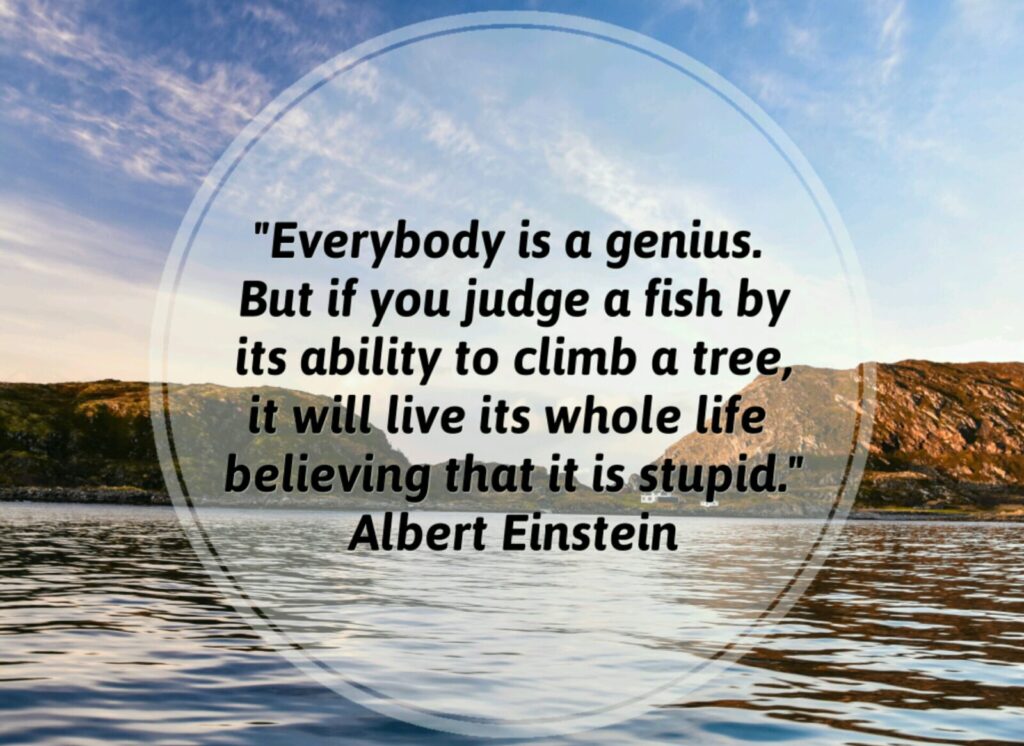
Do not punish yourself for not being good at everything. Human beings are not meant to be excellent in every area. We each carry different combinations of strengths, sensitivities, limitations, and talents. A fish may not be able to climb a tree, but that says nothing about its ability to swim.
In the same way, your worth is not defined by the areas where you struggle, but by the unique way you are able to live, grow, and contribute. So stop comparing your path to someone else’s gifts. Trust your own rhythm. Develop your own strengths. And allow yourself to become fully who you are. Because there is more than one way to be brilliant.